
Anticipatory Bail for 498A (BNS 85): File Before Arrest
Updated · Written by Anant Singh · Legally reviewed by Rahul Pandey
Apply for anticipatory bail under Section 482 BNSS (CrPC 438) as soon as you have concrete reason to fear arrest in a 498A (BNS 85) case. Arnesh Kumar (2014) and Section 35 BNSS limit automatic arrests, and a 2025 Supreme Court order backs a two-month no-arrest period, though its reach beyond Uttar Pradesh is unclear.
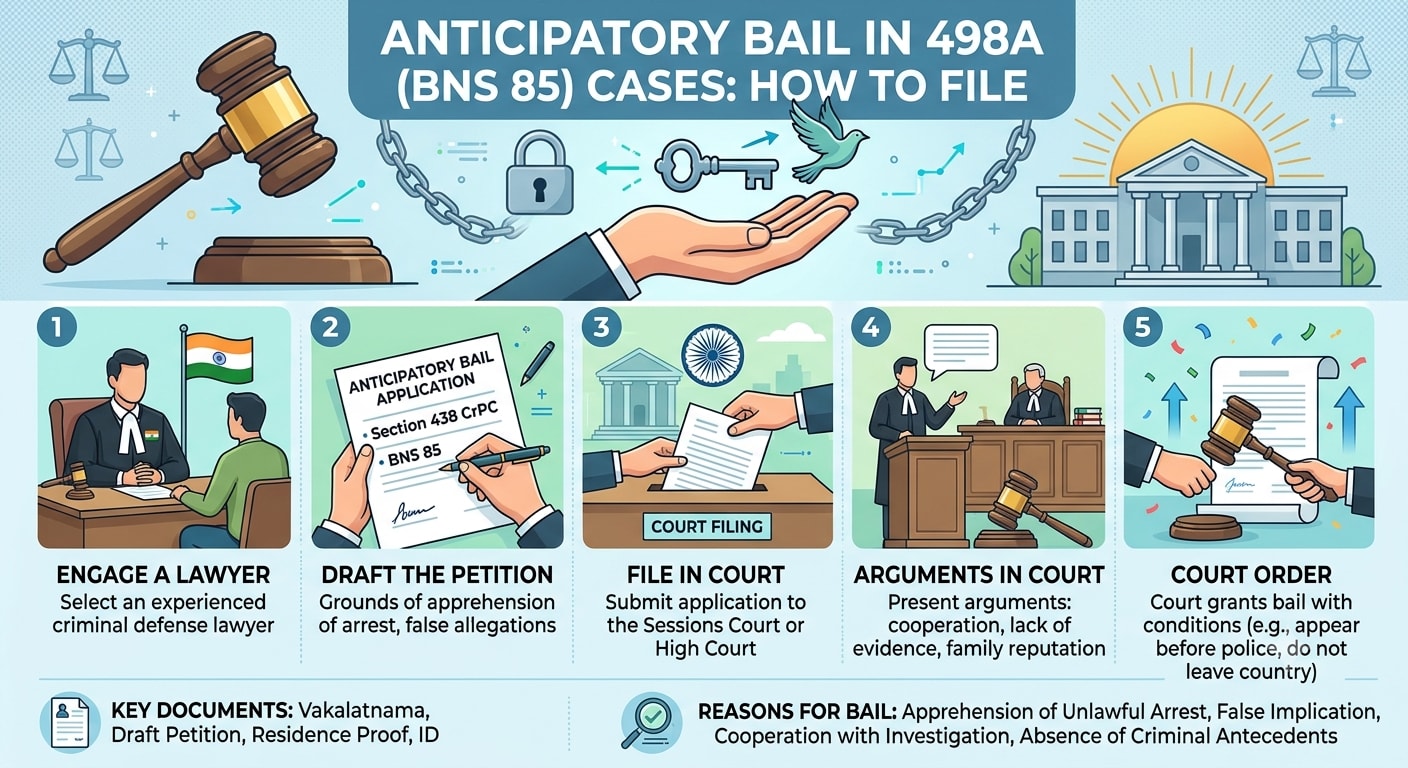
Short answer: if you fear arrest in a 498A case, apply for anticipatory bail as soon as you have a concrete reason to expect arrest. Section 498A of the Indian Penal Code (IPC), now Section 85 of the Bharatiya Nyaya Sanhita, 2023 (BNS), is a non-bailable offence. Anticipatory bail under Section 482 of the Bharatiya Nagarik Suraksha Sanhita, 2023 (BNSS), formerly Section 438 of the Code of Criminal Procedure (CrPC), is the court order that can protect you from arrest. It is discretionary, so preparation matters.
Many 498A complaints are genuine, and courts take them seriously. This guide explains the rights of the accused person and their family. It reflects the law and Supreme Court rulings reported up to 12 November 2026, and it is general information, not legal advice.
What is 498A (BNS 85), and why does it lead to arrest fears?
Section 498A IPC (BNS 85) punishes a husband or his relative who subjects a woman to cruelty, with imprisonment of up to three years and a fine. Section 86 BNS now carries the definition of "cruelty": wilful conduct likely to drive a woman to suicide or cause serious harm, and harassment aimed at forcing her or her family to meet an unlawful demand for property or valuables.
Under the First Schedule to the BNSS, the offence is cognizable, non-bailable and non-compoundable, and is triable by a Magistrate of the first class. Cognizable means police can act without a warrant, but only on information from the woman, a relative of hers by blood, marriage or adoption, or a notified public servant. Non-bailable means bail is not a right and the court decides. Non-compoundable means the complainant cannot simply withdraw the case by private settlement.
The National Crime Records Bureau (NCRB) recorded 1,33,676 cases of cruelty by husband or relatives under Section 498A IPC in 2023, about 29.8% of all recorded crimes against women. Complaints often add other charges: Sections 3 and 4 of the Dowry Prohibition Act, 1961; Section 406 IPC (BNS 316(2)) for breach of trust over stridhan; Section 323 IPC (BNS 115(2)) for hurt; and Section 506 IPC (BNS 351) for threats. If a woman dies within seven years of marriage, Section 304B IPC (BNS 80), dowry death, may be added. That is far more serious, and bail is much harder.
What is anticipatory bail, and when should you file?
Anticipatory bail is a court direction that, if you are arrested, you must be released on bail. Under Section 482(1) BNSS (CrPC 438), a person who has reason to believe they may be arrested for a non-bailable offence can apply to the High Court or the Court of Session. A Magistrate cannot grant it.
- File when the fear is real and specific. Typical triggers are an FIR naming you, a police notice, or a complaint you know has been filed. A vague or general fear is not enough.
- An FIR is not a precondition. In Gurbaksh Singh Sibbia v. State of Punjab (1980), a Constitution Bench held that you can apply before an FIR if you can show concrete grounds for expecting arrest.
- Do not wait for arrest. Once you are arrested, anticipatory bail is no longer the remedy. You would apply for regular bail under Section 480 or 483 BNSS (CrPC 437 or 439).
Can police arrest you immediately after a 498A complaint?
Not automatically. In Arnesh Kumar v. State of Bihar (2 July 2014), the Supreme Court directed that police must not arrest automatically in 498A cases. The key directions were:
- Police must check the arrest-necessity grounds in Section 41(1)(b) CrPC (now Section 35 BNSS), such as preventing further offences, proper investigation, stopping evidence tampering, preventing threats to witnesses, or ensuring the person appears in court, and record their reasons in writing.
- A completed checklist with the reasons must go to the Magistrate when the accused is produced. The Magistrate must record their own satisfaction before authorising detention.
- Where arrest is not needed, the decision must reach the Magistrate within two weeks of the case being registered, and a notice of appearance must be served within two weeks. The Superintendent of Police can extend this for recorded reasons.
- Magistrates who authorise detention without recording reasons can face departmental action by the High Court.
Section 35 BNSS builds this in. Under Section 35(3), police must issue a notice of appearance when arrest is not required. Under Section 35(4), you must comply with it. Under Section 35(5), if you comply and continue to comply, you cannot be arrested for that offence unless the officer records reasons for arrest. The Supreme Court has reiterated these safeguards in later cases, including Satender Kumar Antil v. CBI (2022).
These rules lower the risk of arrest but do not remove it, because police can still arrest if they record reasons. Read more in our guides to Section 35 BNSS notices and your rights in the first 24 hours after arrest.
What is the two-month cooling period in 498A cases?
In Mukesh Bansal v. State of U.P. (13 June 2022), the Allahabad High Court framed guidelines for 498A cases. On 22 July 2025, in Shivangi Bansal v. Sahib Bansal (2025 INSC 883), a Supreme Court bench of Chief Justice B.R. Gavai and Justice A.G. Masih directed that those guidelines "shall remain in effect and be implemented by the appropriate authorities". The guidelines provide that:
- No arrest or police action against the named accused for two months from the FIR or complaint.
- During that period the matter goes to a district Family Welfare Committee, which tries to settle it and then sends a report.
- The investigating officer can still do a peripheral investigation, such as medical and injury reports and witness statements.
- The rule covers 498A cases, and cases where the other sections charged carry less than 10 years. It does not cover cases with serious injury or attempt to murder.
What is unclear: the order arose from an Allahabad High Court framework, and commentators differ on whether it binds police and courts in every state or applies in Uttar Pradesh only. Critics also say it sits uneasily with the Supreme Court's 2018 decision in Social Action Forum for Manav Adhikar v. Union of India, which set aside earlier family welfare committee directions. Ask your lawyer how the High Court and police in your state are treating it, and treat it as an added safeguard, not a substitute. The window ends after two months, and a court order is what protects you after that.
What do courts look at when deciding anticipatory bail?
The power is wide, and the Supreme Court has refused to set a rigid formula (Sibbia). In practice, judges look at:
- Specific vs vague allegations: dates, places, acts and amounts, or only general statements.
- Each person's role: the husband is treated differently from parents, siblings or distant relatives.
- Supporting material: medical records, messages, earlier complaints and evidence of dowry demands.
- Where each accused lives, since relatives in another city or country are less likely to be involved day to day.
- Cooperation: whether you joined the investigation and answered any notice.
- Risk factors: flight, threats to witnesses, destroying evidence and past cases.
In Kahkashan Kausar v. State of Bihar (8 February 2022), the Supreme Court said relatives should not be roped in on omnibus allegations unless specific instances of their involvement are made out. In Dara Lakshmi Narayana v. State of Telangana (10 December 2024), it quashed a 498A case against a husband and his family on vague allegations and noted a growing tendency to use the provision for personal vendettas. It also stressed that its remarks should not weaken genuine complaints. Courts weigh both concerns.
Which court should you approach?
Both the Sessions Court and the High Court can grant anticipatory bail, and many applicants go to the Sessions Court first. If the FIR is registered in another state, the Supreme Court held in Priya Indoria v. State of Karnataka (20 November 2023) that a court can give limited, interim "transit" protection, but only in exceptional and compelling circumstances, when the applicant shows they cannot go to the court with territorial jurisdiction. Ask your lawyer where to file.
What conditions do courts usually impose?
Section 482(2) BNSS lets the court attach conditions, including that you:
- Make yourself available for questioning by police when required.
- Do not directly or indirectly induce, threaten or make promises to anyone who knows the facts.
- Do not leave India without the court's permission.
- Follow any other condition the court could impose for regular bail under Section 480(3) BNSS.
If police later arrest you without a warrant on the same accusation and you are ready to furnish bail, you must be released (Section 482(3)).
How long does anticipatory bail last?
In Sushila Aggarwal v. State (NCT of Delhi) (29 January 2020), a five-judge Constitution Bench held that, as a normal rule, anticipatory bail is not limited to a fixed period. It does not end when a chargesheet is filed or charges are framed, and can continue until the end of the trial. A court may limit its duration in special circumstances, so read your order carefully.
Step by step: what to do before filing
- Get the FIR or complaint. Note every section charged and every person named.
- Do not ignore a police notice. Attend with your lawyer and comply with the Section 35 BNSS notice.
- Collect documents. Marriage and address proof for each named relative, messages and call records, bank transfers, medical records and photographs. Keep originals safe and do not delete anything.
- Do not contact the complainant to pressure or threaten her. Use your lawyer or a formal mediation channel.
- Prepare a specific application. Set out the facts, each person's real role, your ties to your home and work, and an undertaking to cooperate.
- Ask for interim protection until the court decides.
- Attend every hearing and follow every condition. Breaking a condition can lead to cancellation.
Beware of "fixers" who promise guaranteed bail. See our guide to bail agent scams and what a lawyer should cost.
What if anticipatory bail is refused, or you are arrested?
- Go to the next court: the High Court after the Sessions Court, then the Supreme Court.
- If arrested, apply for regular bail under Section 480 or 483 BNSS (CrPC 437 or 439). Our guide to rejected bail applications explains what courts look for.
- Quashing is a separate route. Because 498A (BNS 85) is non-compoundable, a private settlement does not end the case, but the High Court can quash it under Section 528 BNSS (CrPC 482). The Supreme Court has recognised this for matrimonial disputes settled in good faith (B.S. Joshi v. State of Haryana, 2003; Gian Singh v. State of Punjab, 2012).
Mistakes to avoid
- Waiting until after arrest to start preparing.
- Skipping a police notice or hiding from police.
- Contacting the complainant in a way that looks like pressure.
- Filing a vague application that does not say what each person did or did not do.
- Deleting messages or other material.
See the full process in our bail process guide and other bail by offence guides.
Worried about a 498A complaint? Talk to Rihai and we will connect you with a verified bail lawyer in your city.
Last reviewed: [set date after advocate review]. This guide is general information, not legal advice. Laws and court practice change, and each case turns on its facts. Consult a qualified advocate before relying on any point.
Frequently asked questions
Can I get anticipatory bail in a 498A case?
Yes. Section 85 BNS (498A IPC) is non-bailable, so you can apply under Section 482 BNSS (CrPC 438) to the Sessions Court or High Court. Grant is discretionary: courts weigh the allegations, your role, cooperation and risk of tampering or absconding.
Can police arrest me immediately after a 498A complaint?
Not automatically. Under Arnesh Kumar v. State of Bihar (2014) and Section 35 BNSS, police must record reasons why arrest is necessary, or issue a notice of appearance. If you comply with the notice, you cannot be arrested unless police record reasons. Practice varies by state.
What is the two-month cooling period in 498A cases?
In Shivangi Bansal v. Sahib Bansal (22 July 2025), the Supreme Court said Allahabad High Court guidelines stay in effect: no arrest or police action for two months after the FIR while a Family Welfare Committee reviews. Its reach beyond Uttar Pradesh is unclear, so ask your lawyer.
Can I apply for anticipatory bail before an FIR is registered?
Yes in law. In Gurbaksh Singh Sibbia (1980) the Supreme Court held an FIR is not a precondition, but you need concrete facts showing arrest is likely, such as a police notice or a known complaint. Vague fear is not enough.
How long does anticipatory bail last?
Under Sushila Aggarwal v. State (NCT of Delhi) (2020), a five-judge bench held protection normally is not time-limited and can continue until the end of the trial. A court may limit it for special reasons and can attach conditions under Section 482(2) BNSS.
Can my parents and relatives also get anticipatory bail?
Yes, each named person can apply. The Supreme Court has repeatedly cautioned against implicating relatives through vague, omnibus allegations (Kahkashan Kausar, 2022; Dara Lakshmi Narayana, 2024). Courts look for each person’s specific role, dates and acts.
- BNS 85 and the BNSS First Schedule classification, row 85 (cognizable on specified information, non-bailable, Magistrate of the first class)
- BNS 85 and 86 overview (punishment and non-compoundability)
- BNSS Section 35, sub-sections (3) to (5)
- BNSS Section 482, sub-sections (1) to (3):
- CrPC 438 to BNSS 482 mapping and sub-section (4):
- IPC-BNS section mapping (323 to 115(2), 506 to 351, 406 to 316)
- IPC 304B to BNS 80
- Official Government correspondence table, BNS to IPC (Kerala Prisons site)
- Official texts on India Code
- Arnesh Kumar v. State of Bihar (2 Jul 2014)
- Shivangi Bansal v. Sahib Bansal (22 Jul 2025), 2025 INSC 883
- Critique and scope of the cooling-period order
- Gurbaksh Singh Sibbia v. State of Punjab (1980), including pre-FIR anticipatory bail:
- Sushila Aggarwal v. State (NCT of Delhi) (29 Jan 2020)
- Kahkashan Kausar @ Sonam v. State of Bihar (8 Feb 2022):
- Dara Lakshmi Narayana v. State of Telangana (10 Dec 2024)
- Priya Indoria v. State of Karnataka (20 Nov 2023)
- B.S. Joshi v. State of Haryana (2003) 4 SCC 675
- Gian Singh v. State of Punjab (2012) 10 SCC 303, applied under Section 528 BNSS
- NCRB Crime in India 2023 (1,33,676 cruelty cases, 29.8%)
Need emergency bail in Delhi? Talk to someone directly — no middlemen.
Verified bail lawyer in DelhiDon't read alone. Talk to us.
A verified bail lawyer, on a call — no middleman, no runaround.